
The 2026 FIFA World Cup has expanded to 48 teams, giving Asia more qualification spots, but the road to securing a place remains extremely challenging. The Asian World Cup qualification format features multiple rounds and intense competition, making every match potentially decisive.
To stay up to date with the latest developments, fixtures, standings, and results of the Asian World Cup qualifiers, follow Foxscore – your destination for fast, accurate, and comprehensive coverage of every team's journey toward the world's biggest football tournament.
How Has the Asian World Cup Qualification Format Changed for the 2026 World Cup?
FIFA's decision to expand the number of teams participating in the World Cup from 32 to 48 has brought about a major transformation in the global qualification system. For the Asian Football Confederation (AFC), this is considered a historic milestone, as the number of World Cup places allocated to Asia has increased from 4.5 to 8.5. As a result, the Asian World Cup qualification format has undergone a comprehensive overhaul to accommodate the tournament's expanded structure.
In previous World Cup editions, most Asian national teams had to compete fiercely for just four automatic qualification spots and one place in the intercontinental play-offs. Now, the opportunities are considerably greater. However, this expansion has not reduced the level of competition. On the contrary, the Asian World Cup qualification format has been designed as a multi-stage system, giving every AFC member association an opportunity to participate while ensuring that the continent's strongest teams ultimately represent Asia at the World Cup.
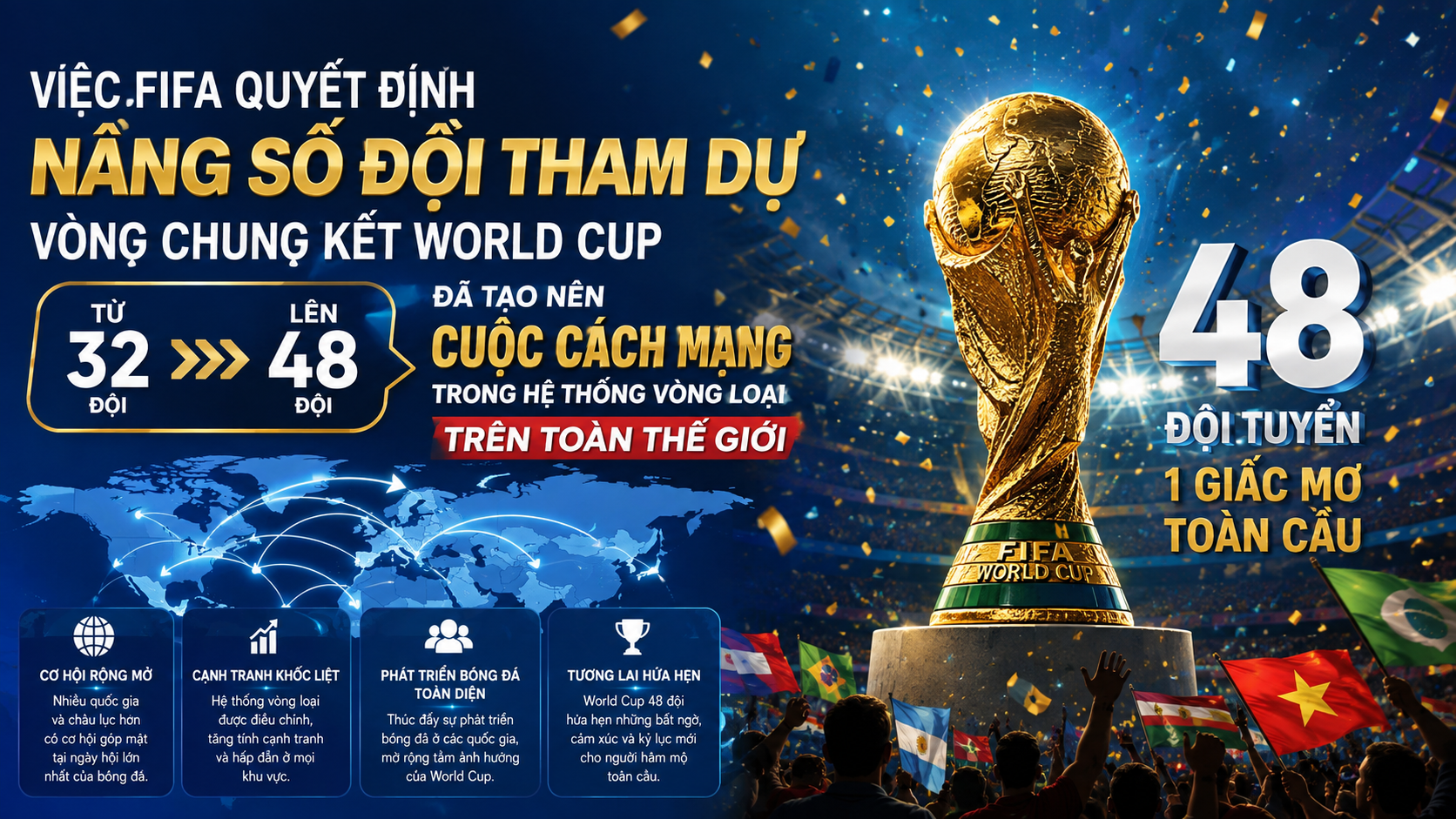
FIFA's decision to expand the number of teams participating in the World Cup from 32 to 48 has brought about a major transformation in the global qualification system
One notable feature is that all 46 AFC member national teams are eligible to participate in the qualifiers. Based on the FIFA World Rankings, teams are divided into different groups to enter the respective stages. This approach helps reduce significant differences in playing standards during the early rounds while creating more balanced and exciting matchups.
Under the Asian World Cup qualification format, lower-ranked national teams must begin their campaigns in the preliminary round. This is considered the first major hurdle for developing football nations such as Guam, Pakistan, Cambodia, Bhutan, and Timor-Leste. Although this stage is relatively small in scale, every match carries enormous significance because a single mistake could bring a team's World Cup dream to an end before the competition has truly begun.
Meanwhile, Asia's leading national teams, including Japan, South Korea, Iran, Australia, Saudi Arabia, and Qatar, receive direct entry into the subsequent round. This allocation system helps maintain competitive standards while giving stronger teams additional time to prepare their squads for the long qualification campaign ahead.
Another important innovation in the Asian World Cup qualification format is the close integration between the World Cup qualifiers and the AFC Asian Cup qualification process. Instead of organizing two entirely separate competition systems as before, the AFC combines the qualification pathways for these two major tournaments to reduce the number of matches, lower organizational costs, and improve overall competitive value. This allows national teams, particularly those with limited resources, to minimize travel while maintaining their opportunities to compete at both continental and global levels.
This change means that every match effectively carries a double purpose. A victory not only brings a national team closer to the World Cup but also opens the door to qualification for the AFC Asian Cup. This significantly increases the importance of every matchday and encourages fans to follow the competition more closely than ever.
Beyond structural changes, the Asian World Cup qualification format also places significant demands on squad depth. National teams must navigate multiple international breaks over a period of nearly three years, with a packed schedule interspersed with domestic leagues, the AFC Champions League, and other international competitions. This requires coaching staffs to develop effective squad rotation strategies while maintaining consistent performances over an extended period.
For developing football nations such as Vietnam, Indonesia, Malaysia, and Thailand, the new format creates greater opportunities to compete for a World Cup place. However, these opportunities can only become reality if teams maintain consistency, accumulate points throughout each round, and make the most of their home advantage against direct rivals.
On the other hand, Asia's traditional powerhouses can no longer afford to be complacent. As more competitive teams emerge, the gap between different football nations is gradually narrowing. Surprises such as Saudi Arabia's victory over Argentina at the 2022 World Cup and Jordan's run to the 2023 AFC Asian Cup final demonstrate how rapidly Asian football is developing. Therefore, the Asian World Cup qualification format is not merely a race for World Cup places but also a reflection of the significant transformation taking place across Asian football in recent years.
It is clear that FIFA's expansion of the tournament has created more opportunities while also making the road to the World Cup longer and more demanding in terms of consistency. This is precisely why the Asian World Cup qualification format is regarded as one of the most exciting and unpredictable qualification systems in the world, where a single mistake can cost a team an entire four-year dream.
Detailed Breakdown of the Asian World Cup Qualification Format: The Long Road to the 2026 World Cup
Looking only at the 8.5 places allocated to the AFC by FIFA, many people might assume that qualifying for the World Cup has become much easier for Asian national teams. However, a closer look at the Asian World Cup qualification format reveals that the journey remains extremely challenging.
Teams must progress through several consecutive rounds over nearly three years, involving dozens of decisive matches. Only those capable of maintaining consistent performances, competitive determination, and sufficient squad depth will ultimately earn a place at the world's biggest football tournament.
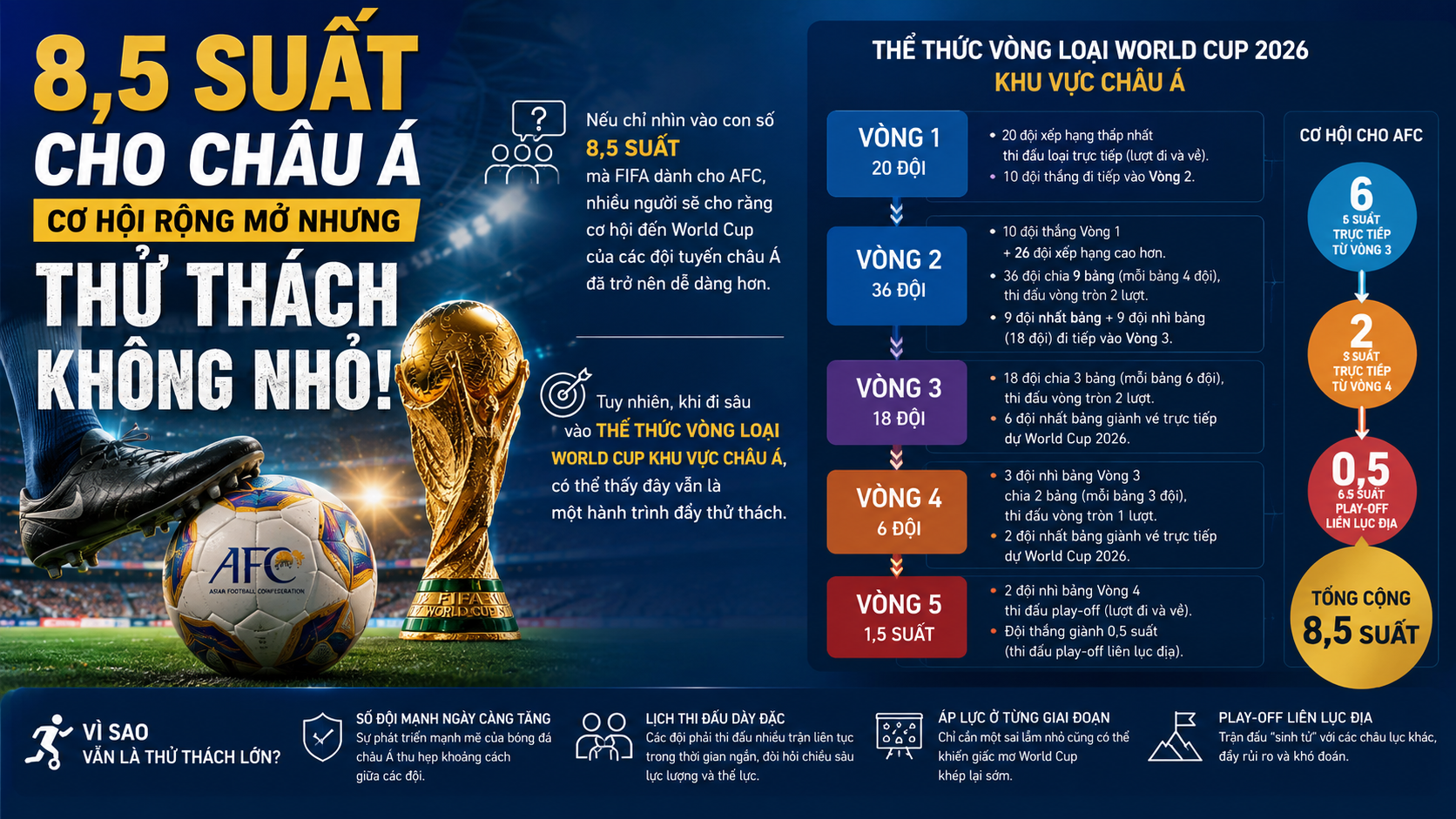
Looking only at the 8.5 places allocated to the AFC by FIFA, many people might assume that qualifying for the World Cup has become much easier for Asian national teams
Preliminary Round: The First Opportunity for Lower-Ranked National Teams
According to the Asian World Cup qualification format, the opening round is reserved for the lowest-ranked national teams in the AFC region according to the FIFA World Rankings. A total of 20 lower-ranked teams are paired into 10 matchups based on seeding principles, with each tie played over two legs on a home-and-away basis.
The knockout format means that every mistake comes at a cost. After just two matches, half of the participating teams will be eliminated, while the 10 winners advance to the second round of qualifying.
Although this stage does not usually attract as much attention as the later rounds, it carries enormous significance for developing football nations. It is not only an opportunity to earn FIFA World Ranking points but also a valuable chance for young players to gain international experience. For many countries, simply progressing beyond the preliminary round is already considered an encouraging achievement.
Second Round: The Beginning of the Real Competition
Following the preliminary round, the Asian World Cup qualification format enters a more important stage featuring 36 national teams. These consist of the 26 highest-ranked teams in Asia and the 10 teams that successfully progressed from the opening round.
The 36 teams are divided into nine groups of four, with each team playing a home-and-away round-robin schedule. Every team plays a total of six matches.
This is the stage where Asia's football powerhouses officially enter the competition. Japan, South Korea, Iran, Australia, Saudi Arabia, Qatar, and the United Arab Emirates are generally considered stronger than most of their opponents. However, the history of World Cup qualifying has repeatedly demonstrated that no group is truly easy.
The appeal of the Asian World Cup qualification format lies in the fact that every match can have a decisive impact. Dropping just a few points against supposedly weaker opponents can completely change the group standings. In recent years, Southeast Asian teams such as Vietnam, Indonesia, and Malaysia have repeatedly caused surprises against higher-ranked opponents, demonstrating that the gap in playing standards is gradually narrowing.
At the end of this round, the top two teams from each group advance to the third round of qualifying. They also secure qualification for the AFC Asian Cup finals. This means that every match is important not only for the World Cup campaign but also for securing a place in Asia's premier continental championship.
Third Round: The Battle Among Asia's Strongest Teams
This is widely regarded as the most exciting stage of the Asian World Cup qualification format. The 18 strongest teams from the second round are divided into three groups of six.
Each group follows a home-and-away round-robin format, with every team playing a total of 10 matches. This stage demands the highest level of consistency because the schedule extends over nearly two years, alongside domestic leagues, the AFC Champions League, and various other international competitions.
Unlike the earlier rounds, the third round brings together almost all of Asia's football powerhouses. High-profile clashes between Japan and Australia, South Korea and Iran, or Saudi Arabia and Qatar are always regarded as some of the biggest fixtures in Asian football.
Under the Asian World Cup qualification format, the top two teams from each group earn direct qualification for the 2026 FIFA World Cup. This means that six Asian representatives secure their places at the final tournament following this round.
This is also the stage where tactical factors become more important than ever. National teams must compete not only in terms of player quality but also in their ability to adjust playing styles, maximize home advantage, manage fitness, and maintain form over an extended period. An injury to a key player or an unexpected defeat can quickly change the entire group standings.
Fourth Round: The Final Opportunity for Teams Still in Contention
Not every team finishing third or fourth in its group is eliminated from the competition. This is one of the features that makes the Asian World Cup qualification format particularly exciting.
The six teams finishing third and fourth in the three groups of the third round advance to the fourth round. They are divided into two groups of three and compete in a single round-robin format at centralized venues selected by the AFC.
Each team plays only two matches, meaning every encounter effectively becomes a final. There is virtually no room for mistakes or second chances.
The winner of each group secures the two remaining direct qualification places allocated to Asia for the 2026 World Cup. As a result, the AFC will have identified a total of eight national teams that qualify automatically for the world's biggest football tournament.
Because this round takes place over a short period and involves enormous pressure, it often produces unexpected results. A moment of individual brilliance, a set-piece situation, or a defensive mistake can determine the fate of an entire qualification campaign that has lasted several years.
Intercontinental Play-offs: The Final Hope for the 8.5th Qualification Spot
Even after the eight directly qualified teams have been determined, the Asian World Cup qualification format still offers another opportunity for the remaining contenders.
The two runners-up from the fourth round face each other over two legs. The winner represents the AFC in the intercontinental play-offs, competing against representatives from other confederations, including CONCACAF, CAF, CONMEBOL, and OFC.
This is considered the final challenge before reaching the World Cup. By successfully progressing through the intercontinental play-offs, Asia can secure its ninth representative at the 2026 World Cup, comprising eight direct qualification places and one additional place earned through the play-off pathway.
Overall, the Asian World Cup qualification format is regarded as one of FIFA's most structured and competitive qualification systems. The increased number of places gives more national teams an opportunity to qualify, but it also demands thorough preparation in terms of technical quality, physical fitness, tactics, and mental strength. Each round has its own characteristics, creating a long and demanding journey that remains highly attractive to football fans across the continent.
Opportunities for Asian National Teams Under the New Format and Key Things to Watch
FIFA's decision to expand the World Cup finals to 48 teams has created a major turning point for Asian football. Under the Asian World Cup qualification format, the increase to 8.5 qualification places gives more national teams an opportunity to fulfill their World Cup dreams. However, greater opportunities do not necessarily mean an easier journey, as competition among football nations across the region is becoming increasingly intense.
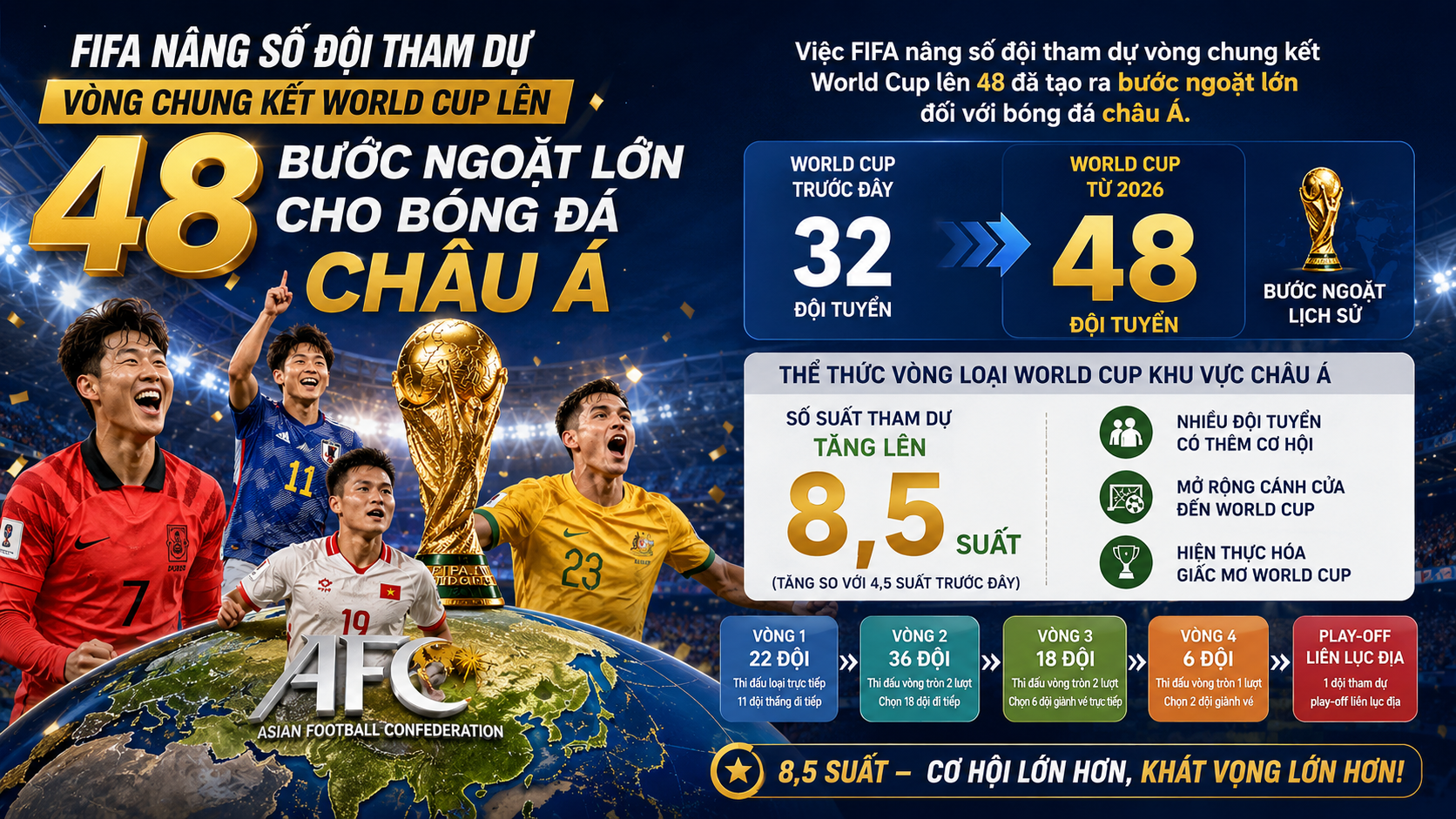
FIFA's decision to expand the World Cup finals to 48 teams has created a major turning point for Asian football
Leading national teams such as Japan, South Korea, Iran, Australia, and Saudi Arabia remain among the strongest contenders for direct qualification. These teams possess high-quality squads, numerous players competing in Europe's top domestic leagues, and extensive experience at previous World Cups. Nevertheless, the Asian World Cup qualification format places considerable demands on consistency, as even a short period of poor form could force these powerhouses into additional qualification rounds filled with uncertainty.
For emerging teams such as Uzbekistan, Jordan, Iraq, Oman, the United Arab Emirates, and Indonesia, the new format provides a clearer pathway to qualification than ever before. Recent developments have demonstrated that the technical gap between Asian teams is gradually narrowing. Jordan's appearance in the AFC Asian Cup final and Indonesia's significant progress are clear examples of how surprises can happen under the Asian World Cup qualification format.
For the Vietnam national team, FIFA's decision to increase the number of World Cup places offers renewed hope to supporters. However, to compete with regional rivals, Vietnamese football needs to maintain a long-term development strategy, invest in youth training, improve the quality of the V.League, and create more opportunities for players to compete internationally. Only by building a sustainable foundation can the national team fully take advantage of the opportunities offered by the Asian World Cup qualification format.
It is clear that the Asian World Cup qualification format is not simply a journey to determine the continent's strongest representatives. It also reflects the remarkable development of Asian football in a new era.
With more qualification places, stronger competition, and greater opportunities for different football nations, the World Cup qualifiers promise to deliver more top-level matches, spectacular breakthroughs, and inspiring stories along the road to the biggest stage in world football.

 0


